Golomb receives $2.6 million NIH grant for visual perception and neuroscience research

Ohio State psychology professor Julie Golomb has received a five-year, $2.6 million grant from the National Institutes of Health to support her ongoing research on visual stability and eye movements.

Awarded by the NIH’s National Eye Institute, it is the third five-year grant that Golomb’s Vision and Cognitive Neuroscience Lab has received for this line of work, which looks at the mechanisms the human brain uses to perceive its physical surroundings consistently.
“Most people rely heavily on visual perception to interpret their surroundings. But our brains encounter a fundamental challenge: spatial information is coded relative to the eyes, and the eyes are constantly moving,” said Golomb, who specializes in cognitive psychology and cognitive neuroscience in the Department of Psychology.
The NIH issued the funding as part of a competitive grant renewal process. With it, Golomb and her team will continue to study visual functioning in healthy people — specifically, how visual processing and neural activity change during eye movements, and how the brain compensates to stabilize perception.
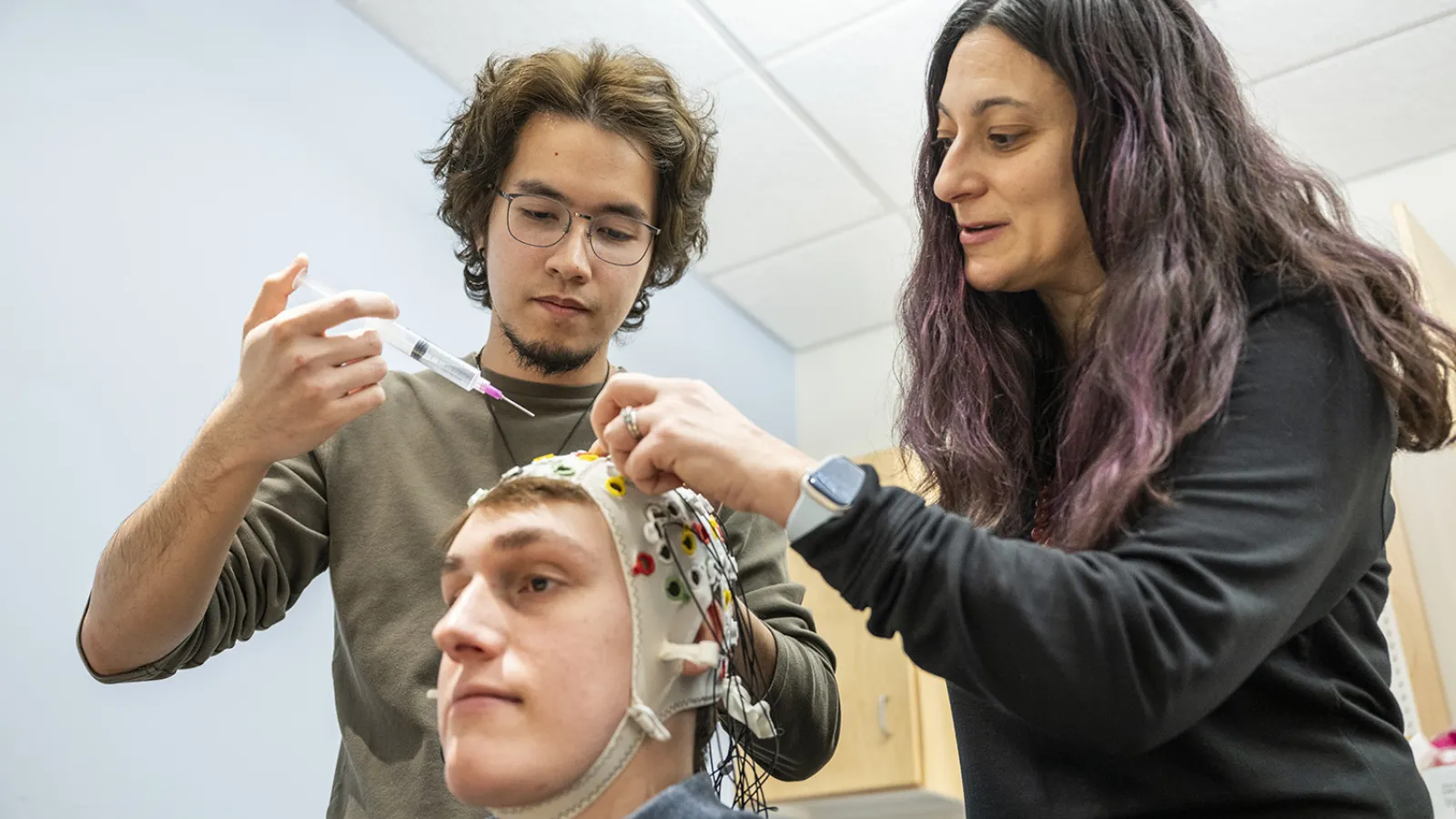
The work involves a combination of behavioral experiments, computational modeling and neuroimaging techniques, including functional magnetic resonance imaging (fMRI) and electroencephalography (EEG). It also uses some of Ohio State’s state-of-the-art facilities and equipment, including those found in the Center for Cognitive and Behavioral Brain Imaging (CCBBI).
Additionally, grant funds will provide financial support for the postdoctoral, graduate and undergraduate researchers helping conduct these studies in the lab.
Studying visual stability “is critical for understanding how the healthy visual system typically works, how these processes are influenced by environmental and cognitive factors, and how these processes may be disrupted in certain individuals,” Golomb explained.
Longer-term, her lab’s findings may offer clues for treatment of visual disorders, help the development of visual prosthetics and artificial intelligence, and have implications for conditions that affect visual processing, such as aging, autism, schizophrenia and depression, she said.